#17: Inside a Real Group Piano Lesson - What Great Group Teaching Actually Looks Like
🎧 Listen Now:
Spotify | Apple | YouTube Video | YouTube Audio | iHeart | Amazon | Goodpods | Pocket Casts
BLOG: Let’s unpack a real class in action - and explain exactly what's happening and why.
There is something that happens when you see a great group piano lesson for the first time.
Something clicks.
All the questions you had - how do you keep them all together? What do you do when someone gets stuck? How do you manage all those different children at once? - suddenly have answers. Because you can see them. Right there, in the room.
That's what you’ll on Episode 17 of the Piano Teaching Success Podcast.
We walk through real footage from one of Paul's group classes - stopping along the way to unpack exactly what is happening, why it works, and what any teacher can take from it.
The children are aged five to seven. They are nine months into their piano journey. Their parents are in the room. And what unfolds over the course of this class is a masterclass in Whole Body Learning, musical preparation, and the kind of joyful, productive energy that makes group piano so extraordinary.
Here is what we saw - and what it means for your teaching.
Group Piano Students Often Learn Faster Than Private Students
The first thing to notice is what happens before the children sit down at the keyboard.
Paul doesn't start with playing. He starts with the body.
Students sing the piece. They pat the notes on their bodies. They feel the staccato in their voices and their movements before their fingers ever touch a key. They work through the two-handed coordination in the air - which hand plays when, how the parts fit together - before any of that has to happen at the piano.
This is Whole Body Learning in action, and it’s crucial for teaching groups.
"We set their ear up and their body up in preparation so they understand what's happening in the music. When they get to the piano, they're all set up, ready to go."
By the time students sit down to play, the piece already makes sense to them. The patterns are in their bodies. The music is in their ears. The coordination has been practiced without the added complexity of the instrument.
This is why group piano students often learn faster than private students.
Why the Body Needs to Learn Music Before the Hands
One of the subtler things happening in this class is the way Paul prepares articulation in the body before asking students to produce it at the keyboard.
This piece is staccato. So the students tap with the staccato quality in their voices and their movements before they play. They are not just learning the notes. They are learning the character of the music - the feeling of it - before their fingers have to recreate it.
"They're doing the articulation with their voice that we want them to do when they play, so we're setting their ear up."
This is a principle that transfers to any piece, any level, any age group. The body learns the music first. Then the hands follow.
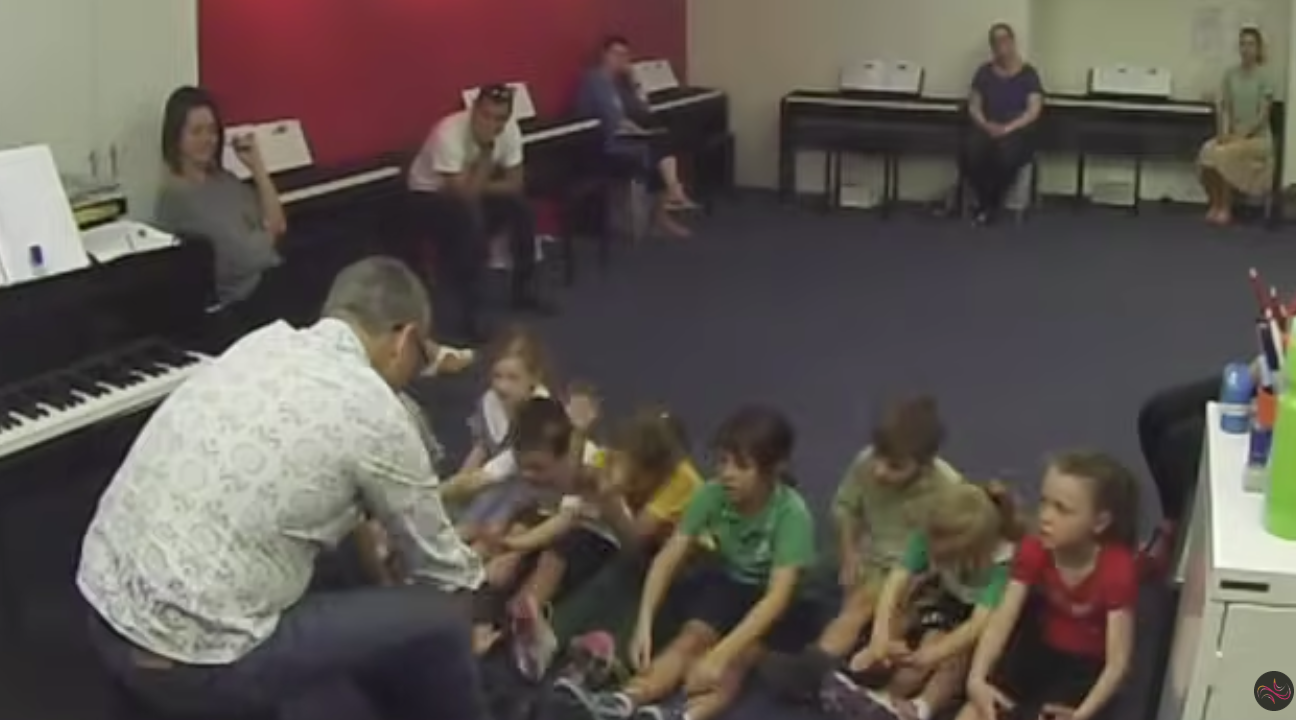
Why Group Piano Has High Retention Rates
Something remarkable happens partway through the class.
Students move from one piano to another - and nobody tells them to. There is no instruction, no countdown, no voice directing traffic.
There is just music! It’s incredible to witness.
Paul plays a particular phrase and the students respond to it. They know what it means. After nine months of learning this way, the music has become its own language in the room.
"Once we train them that when I play this music it's time to move around, they do it without any words at all."
There’s no dead air between activities. No loose cannons running around. No one yawning. No one getting distracted. No one looking at the clock. No one wanting to quit piano.
Just continuous flowing fun and learning and growth.
The Camaraderie that Keeps Kids Loving Group Lessons
Every time students move to a new piano, something sneaky happens.
They have to do the same thing they have just practiced - but in a new spot, with a different person next to them, oriented to a new instrument.
And that small change produces significantly better learning.
"When you do the same thing in a different spot, you actually get really improved learning. They have to do the same thing but orient themselves to something new."
The rotation also builds camaraderie. Students who move through the room together, who share a laugh when someone gets it wrong, who cheer each other on - those students become a community. And communities have a very low dropout rate.
Paul reflects that many of the children from his earliest group classes - now grown up - would arrive thirty minutes early to their senior high school lessons just to socialise with each other. The friendships formed in those early group classes lasted years.
How to Stop Students Crashing Out in Group Piano Lessons
Every teacher watching this footage will recognise the moment.
Students are playing along well, the backing track is running, and then they hit the tricky section at the end - and it falls apart.
This is where many teachers panic. But Paul doesn't.
He stops. He identifies exactly which bit is hard. And he drills it.
"That's what we do when they can't do a bit. We just drill it. A lot of preparation to start with, and then there will be little bits in the piece that are tricky. That's when we drill those bits."
This is important for any teacher worried about managing group learning when students are at different points. The answer is not to try to manage five different individual struggles simultaneously. It's to identify the moment where the group as a whole needs more support - and address it together.
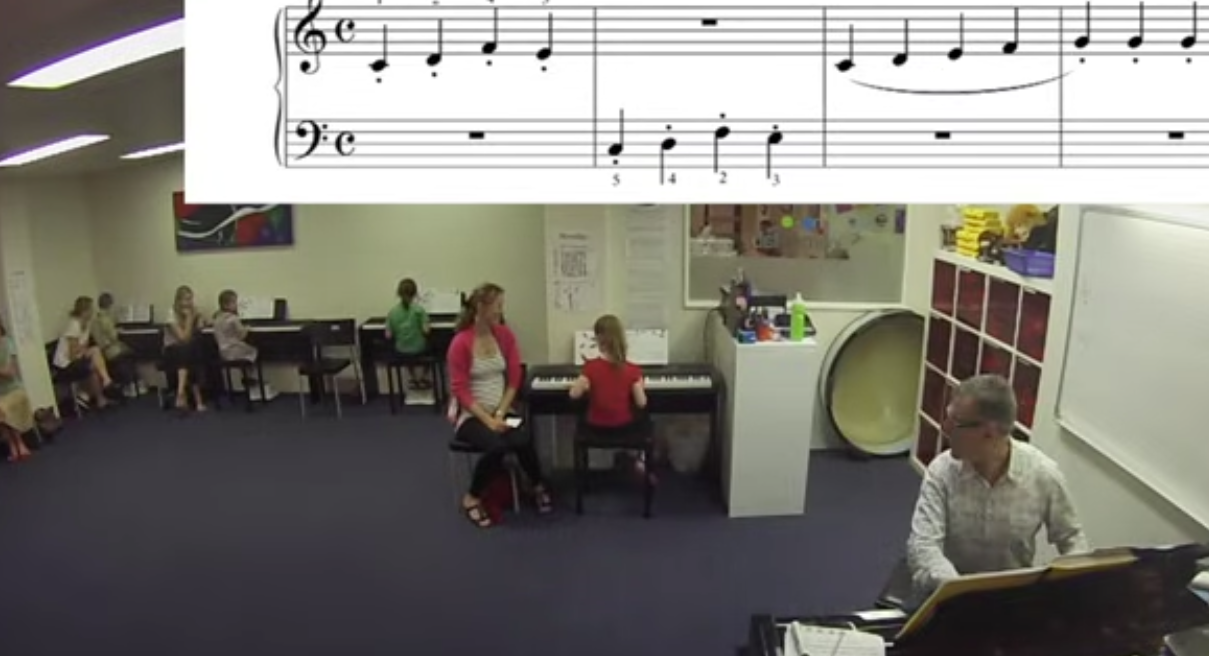
Should Parents Be Involved in Group Piano Lessons?
For this age group - five to seven year olds - parents attend every class.
And this is not just a logistical necessity. It is one of the most powerful pedagogical decisions in the whole model.
Parents who sit in a group lesson see what their child is learning. They see how the teaching works. They understand why the whole body learning activities happen before the piano. They see their child succeeding in front of peers.
And they see other children's progress.
I remember my own own experience as a parent in my children's group classes - watching other children inch ahead during a week where my family hadn't practiced much, and feeling the gentle motivation to do better with practice.
That kind of organic, social motivation is something a private lesson can never provide.
"It's a triangle - the teacher, the parent, and the student. It's wonderful to have parents involved in the lesson so they can see what they need to do at home."
Confidence is Built into Every Group Piano Lesson
In a private lesson, most students perform publicly once or twice a year - at a recital or an exam.
In a group lesson, students perform every single week.
They play in front of their classmates. They play in front of parents. They do solos. They bow at the end. The performance experience is woven into the fabric of every lesson.
"So many kids in a traditional one-on-one lesson are really scared of performing because they never really get to do it much. These kids get to do it all the time and they don't have any problem with performing."
The boy Paul points out in the footage - strolling to the piano, relaxed and confident, timing his entry perfectly because he knows the music so well - is the product of nine months of this.
He's not nervous. He's ready. And he knows it.
The Joy of Teaching Groups
Paul and Gillian share a message in this episode from Bethany, a recent Group Piano University graduate in the US, who just taught her very first group class.
"I just wanted to let you know - I taught my first group of four boys on Monday. They had so much fun and I had triple the fun. Super amazing to see all the work from the summer pay off with the kids actually sitting in my living room ready to learn. They are loving the Whole Body Learning methods."
The joy of teaching groups is not just about what it does for students. It is what it does for teachers too!
"The joy I get out of teaching groups, for me, is one of the loveliest things." - Paul.
How to Start Group Piano Teaching
You do not have to have a big studio. You do not have to have the perfect space. You do not have to have a long waiting list before you start.
Bethany started with four boys in her living room.
I built a school of over 800 students using these same principles.
Every journey begins with one class. One group. One lesson where you try something different and discover what becomes possible.
The point is, just begin. It will all unfold as it is meant to.
Watch or Listen to Episode 17 on the Piano Teaching Success Podcast
🎧 Episode 17 - Inside a Real Group Piano Lesson
Spotify | Apple | YouTube Video | YouTube Audio | iHeart | Amazon | Goodpods | Pocket Casts
Want to Find Out More?
🎉 Group Piano Breakthrough Series - Free Training
A free three-part training that walks you through exactly how the group piano model works.
👉 Register for free here →
Group Piano University - Applications Open
Our next cohort is filling. Don't miss it.
👉 Start your application here →