#6: Before You Start Group Piano, Ask This One Question
🎧 Listen Now: What's Really Happening in Your Students' Brains Right Now Spotify
Spotify | Apple | YouTube Video | YouTube Audio | iHeart | Amazon | Goodpods | Pocket Casts
BLOG: What if the most important question in piano teaching isn’t how we teach…
…but what outcome we’re actually working toward?
When we ask ourselves a bigger question:
What am I actually trying to create here?
What do I want for my students’ musically in 10… 20… even 40 years?
You step back and realise that piano lessons are not only about building life skills. Hopefully we can give them enough musical skills that will enable them to explore music in whatever form that excites them so that music in one form or another becomes a constant, throughout their whole life.
Once I started thinking this way, it enabled me to get clear on what really was important. The “A”s of every exam became less important. Musical skills which are hard to teach in one-to-one lessons became a focus. Along with playing of course! (You can't give up your standards! But both can co-exist at once.)
In fact playing becomes light years better and teaching becomes so much easier when children have good musical skills.
That’s when I began seriously exploring group piano lessons.
The Real Goal of Piano Lessons
When we begin with the end in mind, the goals of piano lessons become much clearer.
When Paul and I were developing our Group Piano Curriculum, our guiding light was this question. What do we want for our students (musically)?
Here’s what we wanted our students to be able to do…
- play confidently and musically
- accompany friends and others
- music skills so they can easily pick up another instrument
- play in school bands or ensembles
- play with friends in a rock band or pop band as a teen
- Play and experience a wide range of musical styles
- improvise and explore their own creativity
- continue playing music for the rest of their lives
In other words, this was going to be bigger than just teaching pieces.
We needed to develop musicianship skills that last a lifetime.
And surprisingly, group learning can be one of the most powerful environments for building those skills.
Why Students Love Learning in Groups
As long as they have the essentials covers eg using a structured curriculum designed for groups, a teaching method that works with different styles of learners simultaneously, the biggest surprise when teachers first experience single level group piano teaching is how much students love it.
Music becomes:
- Social
- collaborative
- motivating
- fun
Students encourage each other.
They practise because they don’t want to be the one left behind. They celebrate each other’s successes.
And over time something remarkable happens.
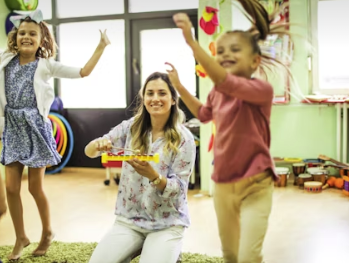
The group becomes a musical community.
We’ve watched students start in groups at four or five years old and continue learning together into their teenage years - developing strong musical skills, performance skills, and a rich love of learning and music - and life-long friendships.
The Skills That Grow Naturally in Groups
With a well structured curriculum, students naturally develop a wide range of musicianship skills:
- strong listening skills
- ensemble awareness
- rhythmic security
- creativity and improvisation
- confidence performing for others
- the ability to adapt to different musical styles
These are the kinds of skills that allow students to pivot into any musical direction later in life.
Rock bands. Jazz. Musical theatre. Church music. Accompanying singers. Film music.
It’s amazing what they can do. Or simply playing for their own enjoyment!
The goal is musical freedom and more choices.
Why Traditional Lessons Often Miss These Skills
Traditional piano lessons tend to focus heavily on:
- note reading
- individual pieces
- technical accuracy
All of which are very important.
But many broader musicianship skills are harder to develop in a one-to-one setting.
For example:
- ensemble playing
- aural skills
- musical interaction
- collaborative learning
Group environments naturally create opportunities for these skills to grow.
What a Real Group Piano Lesson Looks Like
One of the biggest misconceptions about group teaching is that it’s chaotic.
But when groups are structured properly, the opposite is true.
A well-designed lesson has flow.
Activities move quickly.
Students stay engaged.
There’s constant music-making.
And the teacher is free to move around the room, offering individual support while the class continues playing.
Want to See How Group Lessons Really Work?
If you’re curious about group piano teaching, we’ve created a free training video that walks you through the structure behind successful group classes.
🎥 How to Run Professional Group Piano Classes (Without Chaos or Compromise)
Get the free video training here →
Listen or Watch Episode 6
In Episode 6 of the Piano Teaching Success Podcast, we share a real group class in action so you can see what this looks like inside an actual lesson.
🎧 Listen or watch Episode 6 of the Piano Teaching Success Podcast
Listen / Watch on:
Spotify | Apple | YouTube Video | YouTube Audio | iHeart | Amazon | Goodpods | Pocket Casts