#10: How Digital Disruption is Rewiring Students' Brains? - with Dr. Anita Collins
🎧 Listen Now: What's Really Happening in Your Students' Brains Right Now Spotify
Spotify | Apple | YouTube Video | YouTube Audio | iHeart | Amazon | Goodpods | Pocket Casts
BLOG: Why music learning matters more than ever.
There's a conversation happening in staff rooms, studios, and living rooms all over the world right now.
Why are kids so distracted? Why is focus so hard? Why does everything feel like more of a battle than it used to?
Parents, music teachers, and school teachers all sense that something has shifted.
Dr. Anita Collins explains the broader context and how it applies to piano teaching.
Who is Anita Collins?
Dr. Anita Collins is one of the world's leading researchers in brain development and music learning. She's the author of The Music Advantage, the creator of the Don't Stop the Music TV series, founder of Bigger Better Brains, and the person whose TED Talks have introduced millions of people to the neuroscience of music education.
Paul and I had the privilege of hearing Anita deliver the keynote at Top Music Live in Sydney recently. Teachers in that room were scribbling notes and conversations were sparked that lasted beyond the conference.
So, we invited her on the Piano Teaching Success Podcast!
Here’s what we learned…
This Generation Really is Different
Not in the ways we might assume.
Not broken. Not silly. Not lazy.
Different in ways that matter enormously for how we teach them.
"This generation of children is really different — not in the ways we might assume, but in ways that matter enormously for how we teach them."
The children sitting in front of us right now are growing up in a world where information, stimulation, and dopamine hits are available every single moment of every single day.
This is WILDLY different from the way we grew up.
And it’s changing their brains.
This is a neurological reality that we must accept if we are to figure out ways of teaching well.
What is Executive Function — and Why Does It Matter?
Executive function is the set of mental skills that allows us to:
- Focus on a task
- Manage impulses
- Hold a goal in mind and work toward it
- Adapt when things don't go to plan
- Think beyond what’s in front of us
It's the foundation of learning. Of resilience. Of being able to sit with something difficult long enough to get good at it.
And in this generation of students, it's not developing the same way it did before.
Because devices (those brilliantly, addictively designed devices) are doing a lot of that work for them.
The result is students who are in some ways more sophisticated than any generation before them, and in other ways more fragile. More easily overwhelmed. Less practiced at sitting with discomfort. Less experienced at working toward something slowly.
This isn't About Banning Screens
Anita isn’t opposed to tech. She's not saying devices are the enemy. She's not calling for a return to the time before when life was simple and tech-free. Rather, she’s asking us to evolve with it.
"I think it's a wonderful tool for knowledge and communication and all sorts of things. But I do think it's going to require us as humans to grow again."
This is about understanding what's happening so we can respond to it well.
"It's not a don't do it, or do do it. It's not so black and white. It has to be: How do you work with this?"
And working with it means understanding what children need alongside their device use. What experiences balance it. What skills get built nowhere else.
Why Music is Uniquely Placed to Help
The skills that devices are quietly eroding - focus, impulse control, working toward a long-term goal, tolerating difficulty, experiencing the deep satisfaction of gradual mastery - are the exact skills that music learning builds.
Lesson after lesson. Week after week.
"That's where I believe music learning comes into it - it balances the device use and learning on devices."
Every time a student sits at the piano and works through something hard, they are building neural pathways that their devices are not building for them.
Every time they practice, make a mistake, and try again, they are doing something genuinely countercultural in the best possible way.
They are building executive function.
What's Coming Next
Anita believes we are at the beginning of a significant swing.
"We will swing very much back to in-person, analogue experiences - because they're going to be super important for us to remain human."
The pendulum is moving. And the teachers who understand why - who can articulate the value of what they offer in language that speaks to today's parents and today's world - are the ones who will thrive.
What This Means for You
The children in front of you are not a problem to be solved.
They are a generation that needs what you offer more than any generation before them.
When you sit with a student and help them focus, persist, and create something beautiful, you are doing something their devices cannot do. You are giving them an experience that is becoming increasingly rare and increasingly precious.
Piano lessons are exactly what children need right now.
Listen to Episode 10
This conversation will change how you see your students, your work, and your place in their lives.
🎧 Listen to Episode 10 — What's Really Happening in Your Students' Brains Right Now Spotify
Spotify | Apple | YouTube Video | YouTube Audio | iHeart | Amazon | Goodpods | Pocket Casts
Want to go deeper into Anita's work?
Anita’s Program: biggerbetterbrains.com
Anita’s Book: The Music Advantage
Anita’s TED Talk: The Benefits of Music Education
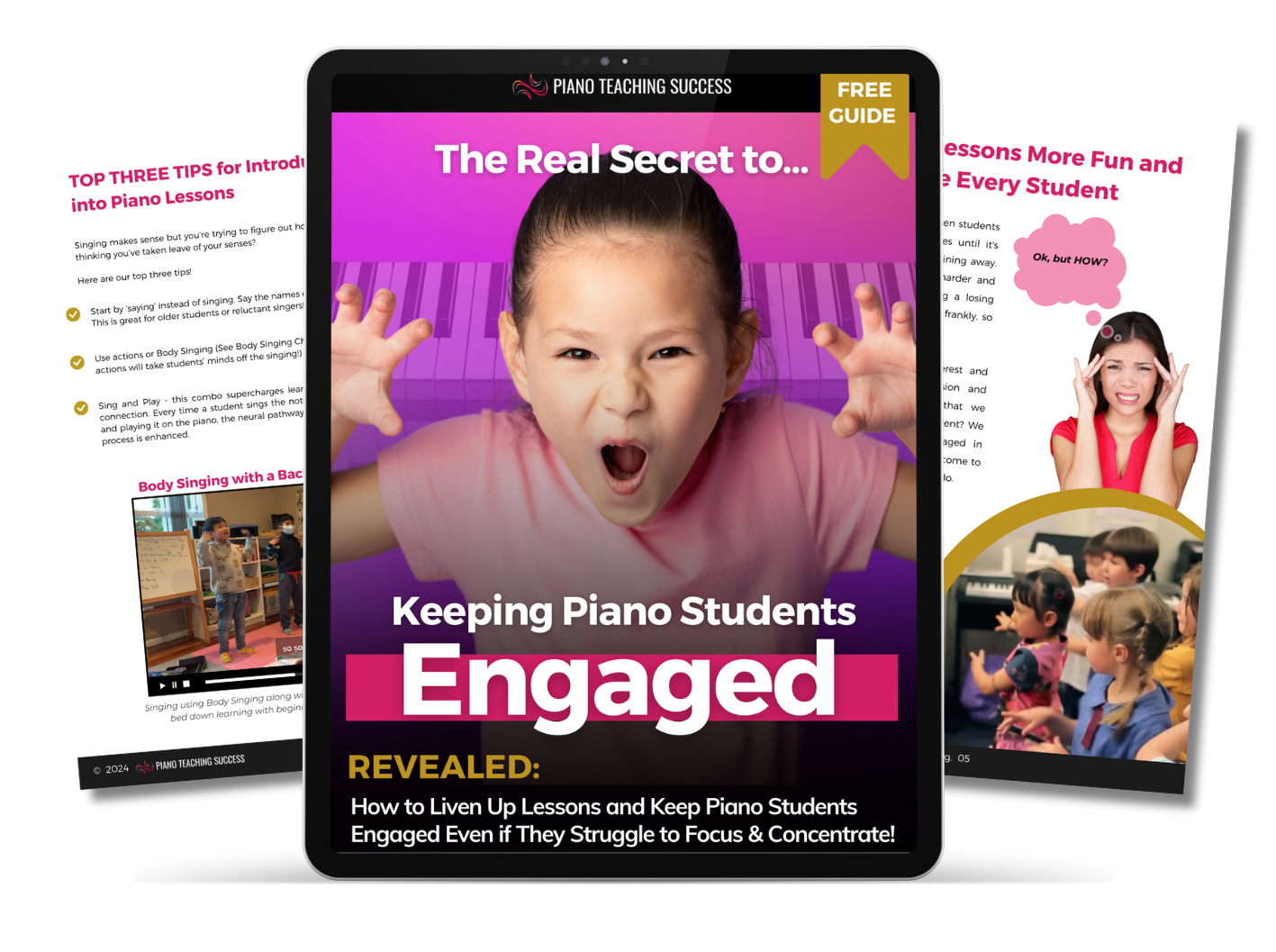
Get Our Free Guide
🎁 Free Download — The Real Secret to Keeping Piano Students Engaged Practical strategies to keep your students motivated, progressing, and loving their lessons. 👉 Download free here → https://www.pianoteachingsuccess.com/lm-keeping-students-engaged-guide